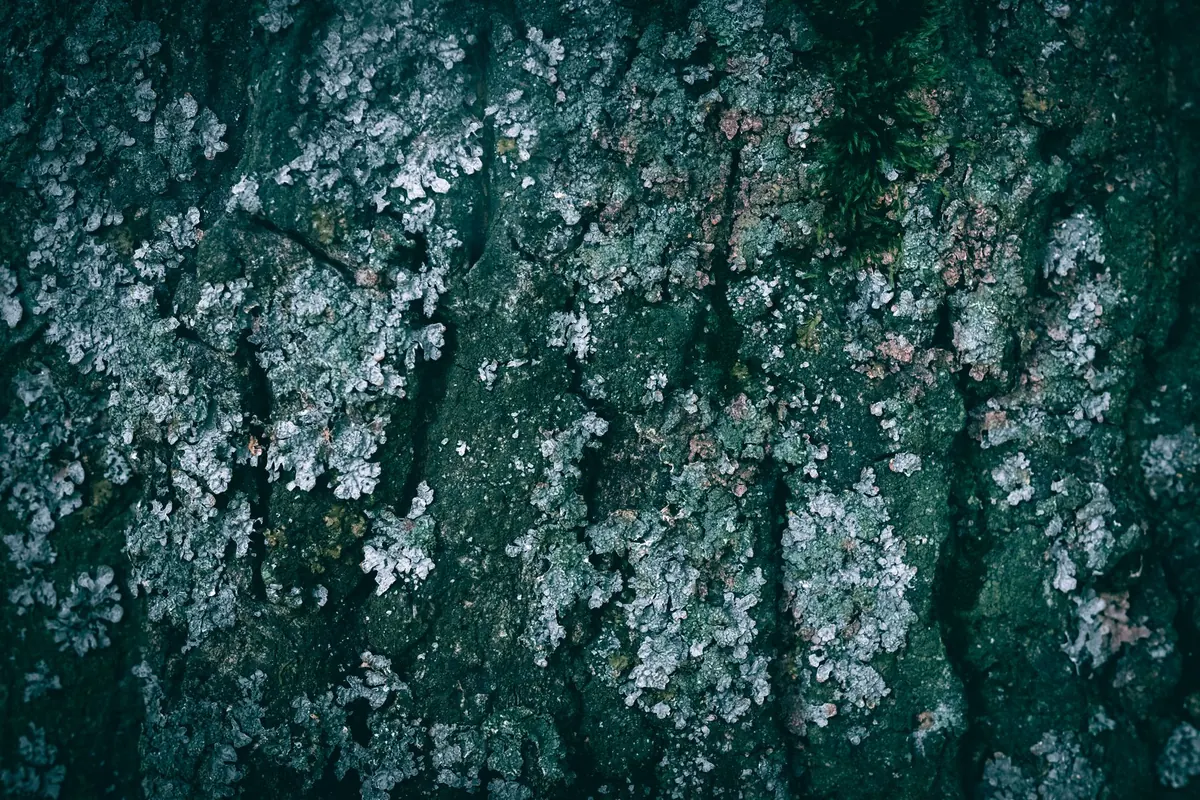
Stand in front of almost any mature tree in Britain and you are looking at an air-quality record. The grey-green crusts, the orange rosettes, the little shrubby tufts on twigs — each one is a living note of what the atmosphere has been delivering. Lichens have no roots to draw from the soil and no waxy cuticle to keep things out. Rain, mist, dust and gases pass straight through them. Whatever is in the air becomes part of the lichen, and only certain species can tolerate certain conditions. That makes them free, widespread and surprisingly readable instruments. You need a hand lens, a notebook and a willingness to look closely.
What a lichen actually is
A lichen is not a single organism. It is a partnership between a fungus and either a green alga or a cyanobacterium. The fungus builds the structure; the partner photosynthesises and supplies sugars. Because the whole thing is exposed and slow-growing, it accumulates what the air brings — sulphur compounds, nitrogen, heavy metals — over years rather than days.
Different lichens have different tolerances. Some shrug off polluted air that would kill others outright. Some are so sensitive that they vanish from a district long before the pollution is obvious to a human nose or eye. That range of tolerance is the whole point: you are not looking for a single species, you are reading a community.
The three shapes you'll meet on bark
Forget species names for a moment. Nearly everything you find on a trunk falls into one of three growth forms, and recognising the form gets you most of the way.
- Crustose — flat and painted-on, tightly bound to the bark. You cannot lift it without taking wood with it. Common examples are the pale grey-green Lecanora species that form speckled plates on walls and trunks, and the grey-brown dots and cracks that look almost like a stain.
- Foliose — leafy and lobed, with edges that lift slightly away from the bark. Hypogymnia physodes has hollow, inflated lobes and a khaki-grey colour. Parmelia sulcata looks like a grey rosette etched with a fine network of white lines. Physcia species are small, pale and often fringed with tiny hairs.
- Fruticose — shrubby or strap-like, standing out from the surface. Evernia prunastri hangs in soft, pale green ribbons, paler underneath, and is the source of the oakmoss scent used in perfumery. Usnea species look like tangled grey-green threads. Ramalina is stiffer and more branched, often on twigs and fences.
When you get comfortable, you will start noticing colour as well as shape. The bright orange-yellow crust of Xanthoria parietina is one of the easiest things in Britain to identify, and it is telling you something specific.
Reading the signs: two pollution stories
Sulphur dioxide and the recovery of our trees
For much of the twentieth century, coal smoke and sulphur dioxide stripped lichens from huge areas of Britain. The classic survivor was Lecanora conizaeoides, a dull grey-green crust that could cope with acidity and sulphur that killed almost everything else. If that was the only lichen on your street trees, the air was doing real damage.
Since the Clean Air Acts and the shift away from coal, sulphur dioxide levels have fallen sharply and sensitive species have been creeping back. Lecanora conizaeoides is now declining in many places, out-competed by the very lichens it once replaced. A trunk covered in a varied, leafy, shrubby community is a sign of air that has improved — often within living memory.
Nitrogen and the orange problem
The current pressure is different. Nitrogen oxides from traffic and ammonia from agriculture enrich the air with nitrogen, which acts like fertiliser for some lichens and poison for others. The winners are easy to spot: Xanthoria parietina, Physcia species and the mustard-yellow granules of Candelariella all thrive where nitrogen is high.
The losers are the clean-air specialists — Usnea, Evernia prunastri, and, in the damp west, the large leafy Lobaria species associated with old woodland. If a tree is thick with orange and nothing else, that is a nitrogen signal, and it is usually strongest beside busy roads, on field edges near intensive livestock units, and under flight paths of prevailing winds from farmland.
A simple survey you can do in an afternoon
- Choose five or six trees of the same species — oak, ash or sycamore are all good, but keep it consistent.
- Work at a standard height, roughly one to one and a half metres up the trunk, so your records are comparable between trees and between years.
- Note the growth forms you can see with the naked eye, then use a hand lens for the crusts.
- Roughly score abundance: absent, rare, frequent, abundant. Precision matters less than consistency.
- Repeat on a second set of trees somewhere different — a churchyard, a park, a lane away from traffic.
- Write the date and the weather. Then come back in six months and do it again.
What can mislead you
Lichens are honest about air, but trees are not neutral surfaces. Bark chemistry matters: oak and birch are acidic and suit a different community from ash, elm and sycamore, which are richer in nutrients. Deep shade, heavy rain, altitude and distance from the coast all change what grows where. A north-facing trunk stays damper than a south-facing one and will usually carry more.
Tree age matters too. Young, smooth bark has had less time to be colonised, and it sheds differently from the craggy bark of an old oak. So compare like with like, and resist the temptation to draw conclusions from a single tree. A useful survey is several trees, in a few places, looked at more than once.
Making it a habit
Start with one tree you pass regularly — on the way to the shops, the school gate, the station. Spend ten minutes on it. Photograph the trunk with your phone, note what is there, and add a second tree nearby. Within a season you will have a small, personal record of your local air, and within a few years something genuinely useful.
If you want to go further, a 10x hand lens is enough for most identification, and field guides to British lichens will take you past the growth forms into species. Local natural history groups and county recorders welcome records, and the odd photograph of an unfamiliar crust is exactly the sort of thing they can help with. But none of that is required to begin. The lichens are already there, quietly keeping score.
Photo: Wyxina Tresse / Pexels