Few garden projects promise so much and deliver so little in their first year as a native wildflower patch. You sow, you wait, and by July you have a rectangle of coarse grass with a few straggly poppies at the edge. It is tempting to blame the seed. Almost always, the fault lies in the method. Native wildflowers are tough, long-lived plants, but they evolved on thin, unfertilised ground and they respond badly to the cosseting we give border perennials. Avoid the five mistakes below and a patch will settle in, thicken up and largely look after itself.
Mistake one: sowing into soil that is too rich
Wildflower seed is often sown into a bed that has just been dug over and enriched. That is the opposite of what it wants. Fertile soil grows lush grass, nettles, dock and fat hen, and those plants will swamp slow-growing seedlings long before they flower. A meadow is not a border. It is a lean system where competition is kept low by poor nutrition.
How to fix it
- Add nothing. No compost, no manure, no fertiliser, no bagged “meadow topsoil”.
- If you are converting a vegetable bed, take off the top 5–10 cm of soil and use it elsewhere.
- On rich ground, strip nutrients by sowing a dense grass crop, cutting it repeatedly and removing every clipping for a season or two.
- Introduce yellow rattle (Rhinanthus minor), a native annual that draws on grass roots and thins the sward. Sow it fresh in autumn.
If you cannot wait for the soil to settle, sow cornfield annuals such as poppy, cornflower and corn marigold first. They tolerate disturbed, slightly richer ground and will give you flowers in year one while the perennials establish beneath them.
Mistake two: buying a mix that does not match your ground
“Wildflower” is a broad label. A mix for chalk downland will sulk on heavy clay; a woodland mix will fail in full sun. Before ordering, note three things: how much sun the patch gets, whether the soil is sandy, loamy or clay, and whether it sits wet in winter. Then match the mix to those conditions rather than to the picture on the packet.
Check provenance, too. Seed of British native origin is what you want, ideally from a supplier working with local stock. Some cheap mixes are padded out with non-native garden flowers that cannot self-sow here and simply vanish. Others include agricultural grasses such as perennial ryegrass, which will outcompete everything you actually wanted.
Look at the grass-to-flower ratio as well. A typical meadow mix is roughly 80 per cent grass to 20 per cent flowers by weight, and the grass should be fine-leaved natives such as crested dogstail, red fescue and common bent. Deciding between annual and perennial matters, too: annuals give a fast show and disappear, perennials take two or three years and then persist. Scattering a little cornfield annual seed over a perennial sowing gives you both.
Reading the label
- Habitat: chalk, clay, wet meadow, woodland edge, coastal. Buy the one that matches your site.
- Origin: British native provenance, preferably local to your region.
- Grasses: fine-leaved natives only. Avoid ryegrass, cocksfoot and other agricultural thugs.
- Ratio: around 80:20 grass to flowers for a meadow; higher flower content for a small border-style patch.
- Annuals vs perennials: annuals for year-one colour, perennials for the long haul.
The cheapest mix is rarely the bargain it looks. If half the seed is unsuitable, you have paid twice: once for the packet and again for the replacement sowing.
Mistake three: sowing too thickly, too deep, or too loosely
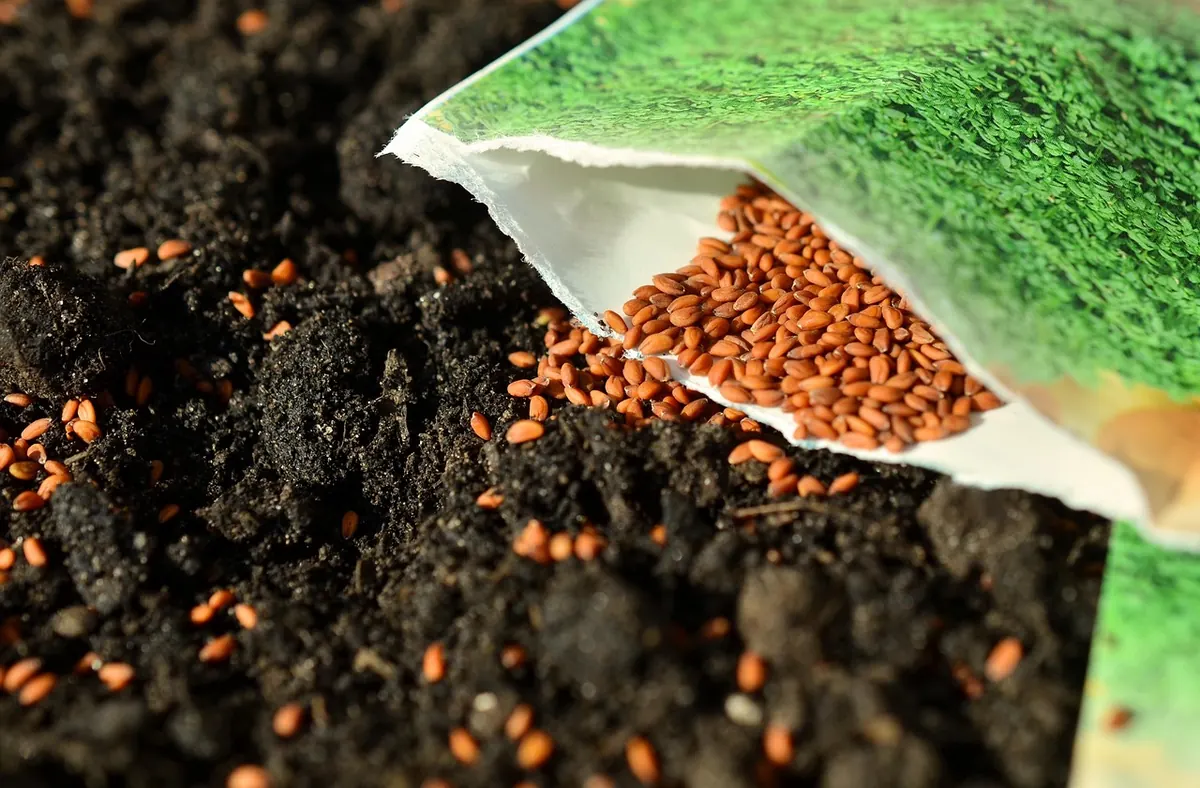
Seed is expensive, and the instinct is to be generous. Resist it. Over-sown wildflowers produce weak, spindly plants that never fill out. Follow the rate on the packet; as a rough guide, that is usually 1–2 g per square metre for a pure wildflower mix, or 5 g per square metre for a meadow mix that includes grasses. Sowing too deep is the other common error. Most wildflower seed needs light to germinate, or at most a dusting of soil. Bury it under a centimetre of compost and you have made expensive bird food.
Uneven sowing is just as bad. You end up with bald patches and dense clumps, and the clumps shade out the gaps. The fix is simple: divide the seed into two equal batches. Sow the first batch over the whole area in one direction, then sow the second batch at right angles. Mix the seed with dry sand, vermiculite or flour to see where it has landed, and rake it in very lightly.
Getting the sowing right
- Clear the ground of existing weeds and grass. Do not dig deeply; scrape or lightly fork the surface.
- Firm the seedbed by treading or rolling. A loose bed dries out and seed sinks unevenly.
- Mix seed with dry sand or flour at about 10 parts carrier to 1 part seed.
- Sow half the mix in one direction, half at right angles.
- Rake very lightly, then firm again with a board or roller. Do not cover with soil or compost.
- Water gently if the weather is dry, but do not soak. Native seed is adapted to patience.
Mistake four: sowing at the wrong time of year
Timing matters more than most gardeners expect. Spring sowings often fail because the soil warms up slowly and weeds get a head start. Autumn is usually better: the soil is still warm, rain is more reliable, and many native perennials need a period of cold to break dormancy. In most of the UK, late August to mid-October is the sweet spot. On light, free-draining ground, early September is ideal. On heavy clay, sow a little earlier so the seedlings have time to root before winter waterlogging.
Spring sowing is not impossible, but it is a gamble. If you must sow in March or April, be prepared to irrigate in dry spells and to mow or hoe weeds relentlessly. Cornfield annuals are the exception: they can be sown in spring for a summer show, but they will not persist without resowing.
When to sow
- Late summer to mid-autumn: best for most perennial meadow mixes.
- Early spring: acceptable on light soils or with irrigation, but expect more weeds.
- Frosty or waterlogged ground: wait. Seed sown into cold, wet mud simply rots.
Mistake five: walking away after sowing
A wildflower patch is not a “plant it and forget it” project, at least not in the first two years. The most common disappointment is a patch that is left completely unmown. The grasses grow tall, flop over, and smother the flowers. The second most common is a patch that is mown like a lawn, which removes the flower buds before they can open. The answer is a middle path: mow in the first year to control weeds and encourage tillering, then mow once a year after the flowers have set seed.
Weeding matters, too. In year one, pull or hoe obvious thugs such as thistle, dock and nettle before they set seed. Do not expect a pristine meadow. A little untidiness is part of the deal, but you can still steer the patch away from a takeover by one or two aggressive species.
First-year aftercare
- Mow to about 5–7 cm whenever the sward reaches 15 cm, removing the clippings.
- Stop mowing once flowers begin to open, usually in late spring or early summer.
- After flowering, let seed drop, then cut the whole patch to 5–10 cm in late summer or early autumn.
- Remove all cuttings. Leaving them adds fertility and encourages rank grass.
- Water only in prolonged drought. Established native plants should fend for themselves.
A simple first-year calendar
- Late summer: clear the site, firm the seedbed, sow, and water gently.
- Autumn: keep the surface moist if the weather is dry. Remove any obvious weed seedlings by hand.
- Spring: mow lightly if the grass grows ahead of the flowers. Do not let it smother the seedlings.
- Early summer: stop mowing. Watch for the first flowers, even if they are only cornfield annuals.
- Late summer: let the perennials set seed. Cut and clear the
Photo: congerdesign / Pixabay