How to Read a Hedgerow: A Seasonal Guide to Structure, Plants and Wildlife
A hedge is not a fence. It is a wood folded into a line, and like a wood it has layers, seasons and residents. Drive past and you see a green wall; walk past at the pace of a conversation and you see buds you can name, nests you can spot in February, and berries you can pick in October. Reading a hedgerow is a habit rather than a technique: shape first, then plants, then the signs of everything that has used it. You do not need to be a botanist. You need a slow ten minutes, a rough idea of what you are looking at, and the willingness to come back later in the year.
Every hedge is a document. Its height records the flail, its bank records an old boundary, its flowers record the soil, and its gaps record the weather, the stock and the neighbours. The more often you read the same hedge, the more you notice: which blackthorn flowers first, where the wren slips through, which gap the badger uses. This guide is arranged the way I read a hedge — architecture, plants, then the year — with a few extra sections on wildlife signs and practical surveying.
Start with the structure
Stand a few paces back and read the hedge as architecture. Three things matter: height and density, what comes out of the top, and what runs along the base.
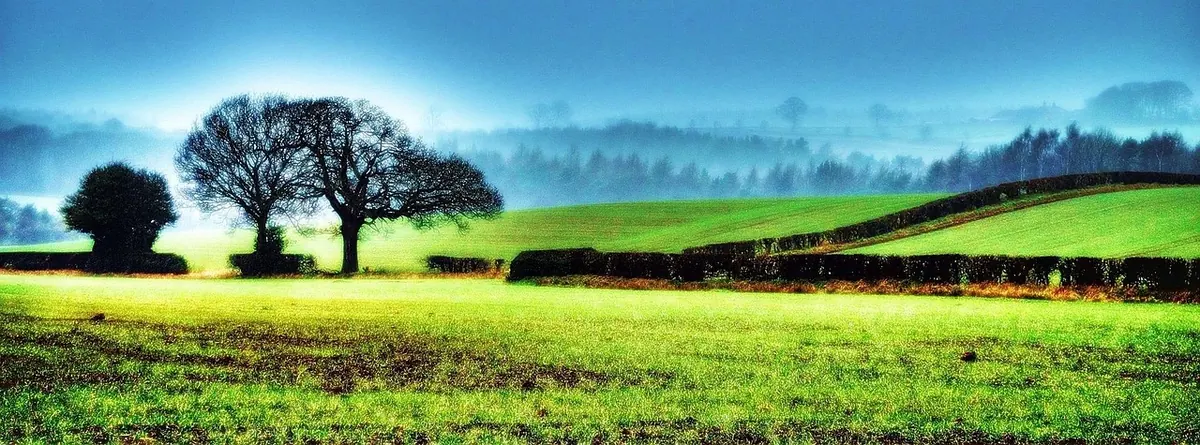
A hedge roughly two metres tall, wider at the bottom than the top, lets light reach the ground and keeps a sheltered core. That triangular profile is not just tidy; it is functional. The base stays leafy, the middle stays dense enough for nesting birds, and the top can be trimmed without destroying the whole year's growth. One flailed flat to chest height every year has neither: the base is shaded out, the fruit crop is thin, and there is nowhere safe for a wren to nest. A hedge cut to the bone in autumn may look neat, but it has removed the berries that would have fed redwings in January and the seed heads that would have stood through winter.
Look for variation along the line. A good hedge is not uniform. It has tall patches and low patches, dense blocks and thin places, perhaps a gap where a gate once stood. Those irregularities are habitat. A south-facing edge warms early and attracts basking insects; a shaded north side stays damp and grows mosses and ferns. If the hedge is a single line of identical hawthorn, it may still be useful, but it will hold far less than a mixed, uneven hedge with a rough base.
Standards, banks and ditches
Look for trees growing out of the line — oak, ash, field maple. They usually mean the hedge has been laid rather than machine-cut, with the odd standard left for timber. Standards also lift the canopy, letting light down to the hedge plants below. Now look down. A raised bank with a ditch beside it is often older than the planting on it, a boundary marked out when the fields were first drawn. The ditch may be on one side or both; it may hold water in winter and be dry in summer. Either way, it is a clue to age and drainage.
Straight, flat hedges of a single species tend to belong to the enclosure period, when fields were reorganised and boundaries were planted in straight lines. Sinuous hedges that follow a stream or a slope are often older, perhaps remnants of medieval field systems. A hedge that runs along a parish boundary may have been managed for centuries, and its species list can be remarkably rich. None of these rules is absolute, but they give you questions to ask: Who planted this? Why here? What was the land like before?
What the plants tell you
There is an old rule of thumb: count the woody species in thirty metres and treat each one as roughly a century of age. Use it as a hint, not a measurement — soil, shade and cutting all interfere with it. Still, a line of hawthorn alone is young; hawthorn, hazel, field maple, dogwood and spindle together is not. Add blackthorn, dog rose, wild privet, guelder rose and buckthorn, and you are reading a hedge that has had time to accumulate diversity.
What grows beneath can be more telling. Dog's mercury, bluebell, wood anemone, primrose or early purple orchid along the base suggests an old woodland edge, perhaps a strip of a wood long gone. These plants are slow to spread, so their presence is a strong hint of continuity. Nettles and cleavers point the other way, to fertile ground enriched by spray drift, run-off or stock. Neither is a moral judgment; they are simply evidence of nutrients and disturbance.
How hard the hedge is cut shows in the base too. Cow parsley, hogweed, woundwort and figwort flowering there mean the flail is not being taken to the bone each year — and those rough, untidy edges are exactly what insects use. Leave some stems standing through winter and you leave homes for beetles, solitary bees and overwintering larvae. A hedge with a scruffy skirt is often a hedge with a pulse.