Leaves are the easy part. Come November most of us stop naming trees and start calling everything “that big one by the gate”. Winter, though, is when a tree shows you its bones. The clues it leaves behind — buds, twig colour, bark, the outline it draws against a pale sky — are there all season, and they change far less than foliage does. You do not need a botany degree. You need a routine, a hand lens if you have one, and the patience to stand under the same tree twice.
Three clues, in order of usefulness
Start with the buds. They are formed the previous summer and sit tight through the cold months, which makes them far more consistent than bark. Look at shape, colour and texture: rounded or pointed, smooth or velvety, sticky or dry.
Next, the twig itself. Colour matters — purple-brown, olive-green, grey, reddish. So do the leaf scars left where last summer’s leaves dropped, and the small speckles called lenticels that speckle the young growth of many species.
Bark comes third, not first. Age, soil and situation all change it. A young oak and an old oak look nothing alike, and a beech grown in a windswept hedge is grey and smooth while a woodland beech is a column of matted ridges.
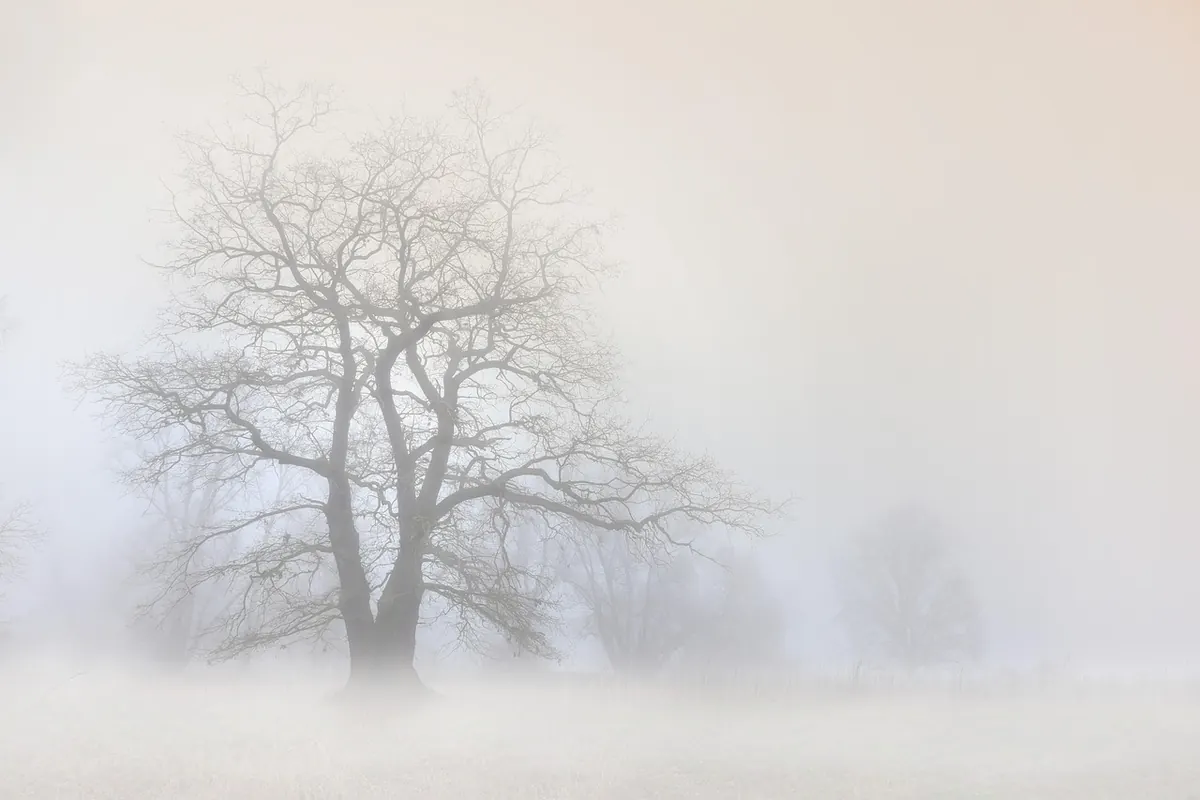
Silhouette comes last and is the most satisfying of all, because you can read it from twenty metres away with cold hands still in your pockets.
Opposite or alternate?
Hold a twig between finger and thumb and look at where the buds attach. If they sit in pairs, directly across from each other at the same point on the stem, the tree has opposite buds. If they zig-zag alternately up the twig, it has alternate buds. Most British trees are alternate, so the common exceptions instantly halve the possibilities.
- Opposite: ash, sycamore, horse chestnut, elder, field maple.
- Alternate: oak, beech, silver birch, hawthorn, hazel, alder, willow, lime.
Four trees with opposite buds
Ash
The easiest of the lot. Its buds are stout, black and velvety, like tiny hooves, held in opposite pairs on grey twigs. Look up for clusters of ash keys — dry, brown and wing-shaped — which often hang on well into winter. Older trees have pale grey bark grooved into a diamond pattern.
Sycamore
Big, fat, green egg-shaped buds, the colour of a spring lawn in the middle of a grey month, sitting opposite on stout twigs. Mature bark flakes in grey-brown scales, and pairs of winged seeds frequently hang on into December. Exposed trees lean and twist, so do not expect a textbook shape.
Horse chestnut
Buds are large, pointed, reddish-brown and sticky in early winter — the resin is a protective coating, not sap. Below each bud sits a leaf scar shaped like a horseshoe, with the bundle scars inside it like nail prints. Bark breaks into flat plates on older trees.
Elder
Dark, almost purple-black pointed buds in opposite pairs on greenish twigs. The giveaway is the bark: grey-brown and corky, covered in warty ridges and lenticels, especially on older wood. Elders usually grow as scrubby, multi-stemmed bushes rather than proper trees.
Six trees with alternate buds
Oak
Buds are rounded, brown and often clustered in a bunch of two to five at the tip of the twig — a useful quirk once you notice it. Bark is deeply fissured and rough. Mature oaks carry thick, crooked limbs that seem to change direction halfway along; the silhouette is heavy and stubborn rather than tidy.
Beech
Long, slender, sharply pointed buds, copper-brown and held clear of the twig at an angle. Smooth grey bark stays smooth even on big trees, sometimes with faint horizontal lines. Hedgerow beeches often keep their dead leaves all winter, which is almost a signature.
Silver birch
Slender purple-brown twigs with small pointed buds and catkins that already hang in pairs through the coldest months. Bark peels in papery white strips marked with dark horizontal lenticels. In a stand, birch reads as pale verticals; in a mixed hedge, look for the colour of the twigs.
Hawthorn
Small reddish-brown buds and sharp thorns on the same twig — thorns are modified shoots, and they will still be there when the leaves are not. The tree itself is dense and tangled, with dark, shallowly fissured bark and a habit of leaning with the prevailing wind.
Hazel
Fat, oval, greenish-brown buds that look too big for the twig holding them. From January the yellow-green catkins dangle like lamb’s tails. Hazel is often coppiced, so you usually meet it as a cluster of slim stems rising from one base, with smooth, shiny olive-brown bark.
Alder
Small stalked buds on purplish-brown twigs, with orange-brown lenticels on young growth. The clincher is the little woody cone: old female catkins stay on the tree all winter, usually in groups of two or three. Alders are almost always near water or on wet ground.
Reading the silhouette
Stand back and let the whole tree tell you something. Shape, branch angle and crown density narrow the field before you touch a twig. Oaks look broad and heavy, with limbs that appear to change their mind; ash is more upright, with a knobbly, bunched crown; birch is fine and upright; hawthorn is a low, bristling thicket. Where the trunk forks, and whether the main branches sweep upward or spread outward, matters more at distance than any individual bud.
Then glance down. Everything under the tree is part of the identification: beech mast husks, conker cases, alder cones, birch catkin scales, the shrivelled remains of ash keys. A tree and its litter are one clue, not two.
Habits that make winter identification easier
- Learn one tree properly before attempting ten. Ash on your own street is a better teacher than a whole wood.
- Carry a hand lens. Lenticels and leaf scars look completely different at ten times magnification.
- Photograph a twig against a plain background with a coin beside it for scale, then compare at home in comfort.
- Check the ground beneath before you look up.
- Use situation as a filter: alder by water, hazel in coppiced woodland, beech on thin chalky or sandy soils.
- Revisit in May. Finding out you were wrong is how the correction sticks.
Try this on your next walk
Pick a short route you walk often and choose three
Photo: Peggychoucair / Pixabay